The GPA you see on your high school transcript and the GPAs considered by UC for admission are different. UC recalculates from scratch, and the rules it uses can swing the result by several tenths of a point. Here's how that calculation works and how the UC GPA Calculator runs it for you using your school's actual UC-approved course list.
Which courses and years count
UC calculates your GPAs using A-G courses taken in 10th and 11th grade only. 9th grade and 12th grade courses do not count toward the GPAs, even though they still matter for meeting subject requirements.
Only A-G coursework (the college-preparatory classes UC recognizes across seven subject areas) is included in the UC GPA calculations. Non A-G electives are excluded.
How grades are assigned points
UC assigns every eligible course a base point value, then adds weight for honors. Each letter grade earns the base points shown above, before any honors bonus is applied.
Plus and minus grades don't change the UC GPA: A+, A, and A− all count as 4 points.
The three UC GPAs
UC utilizes three different GPAs in their assessments, and the calculator updates and displays all three as you enter courses.

Honors weighting
Eligible honors courses earn 1 extra point per semester for grades of A, B, or C (a D or F earns no bonus, even in an honors class).
- California residents: AP, IB, UC-transferable college courses, and UC-certified honors courses are eligible.
- Non-residents: only AP and IB courses are eligible.
The honors caps
UC limits how many bonus points can apply to the Capped Weighted GPA:
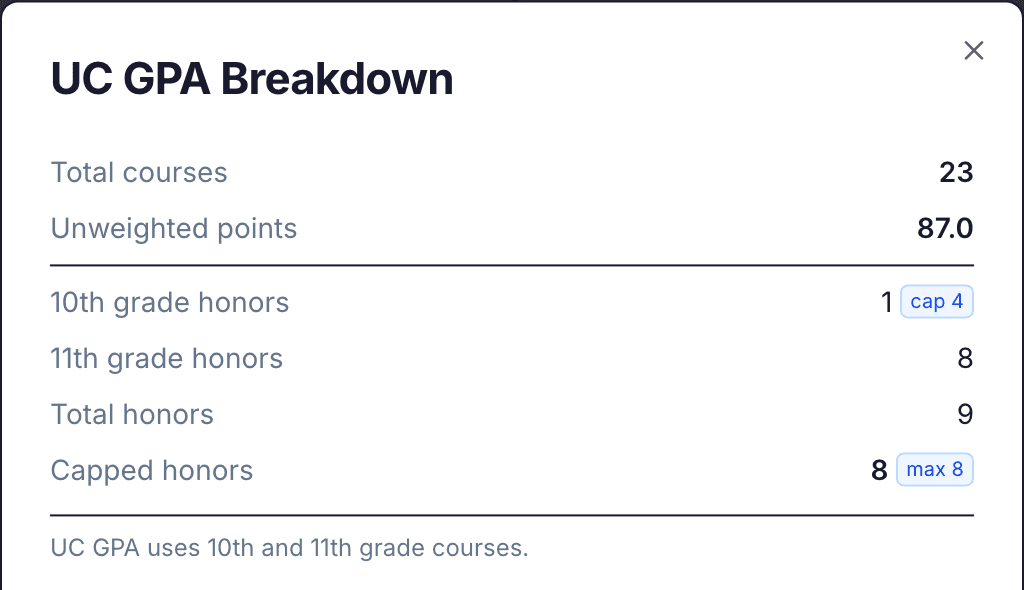
- Maximum 4 honors points from the 10th-grade period (including the summers before and after 10th grade)
- Maximum 8 honors points total across 10th and 11th grade
The Fully Weighted GPA ignores these caps and counts every eligible honors point.
An example
Say a student takes 12 A-G semester courses across 10th and 11th grade — a realistic mix of grades, with honors-eligible courses in both years:
Every A, B, and C in an eligible honors course earns 1 bonus point, so all 12 honors courses here earn their bonus.
- Unweighted: 43 ÷ 12 = 3.58 (no honors bonus)
- Fully Weighted: (43 + 12) ÷ 12 = 4.58 (all 12 honors points count)
- Capped Weighted: the 6 honors points earned in 10th are first capped to 4 (the 10th-grade limit), giving 4 + 6 = 10; that total is then capped to 8. So (43 + 8) ÷ 12 = 4.25.
Here the caps cost this student 0.33 between the Fully and Capped Weighted GPAs. Students with many AP/honors courses are the ones who see the two diverge — if you earn 8 or fewer honors points (and no more than 4 from 10th grade), nothing is capped and the two GPAs match.
How the calculator does it for you
Instead of guessing which of your courses are honors-eligible, the calculator pulls your high school's official UC-approved course list, so honors designations are applied automatically and correctly for the catalog year you select.
The calculator applies California-resident honors rules. If you're a non-resident, only AP and IB courses earn the bonus (not UC-certified honors or college courses), and the minimum UC GPA required is 3.4 rather than 3.0 read your result with that in mind and verify with your school counselor.
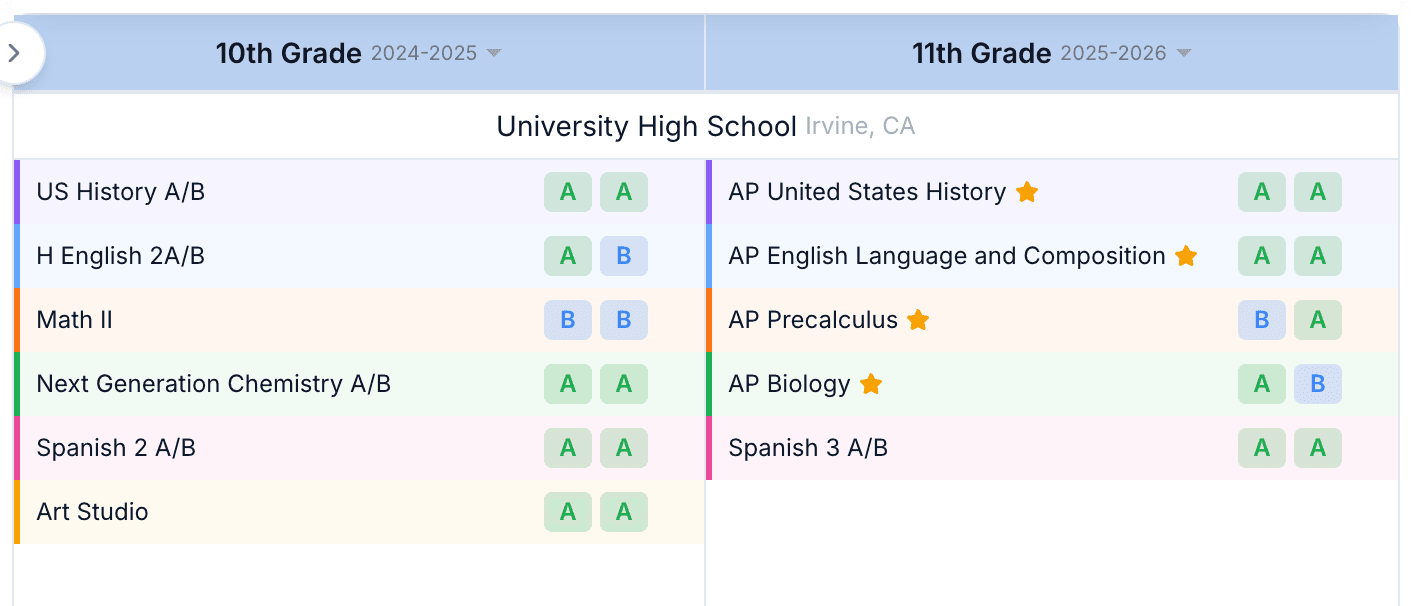
Click any GPA badge to see exactly how the number is built:
You can also add schools not found in the list or UC-transferable college courses manually when you need to model transfers, dual enrollment, or a school that is not yet in the catalog. Use the PL status for planned or in-progress courses you'd like to keep on your list without counting toward the GPA yet.
Minimum GPA for eligibility
California residents need a minimum 3.0 UC GPA, and non-residents a minimum 3.4, to meet UC's GPA eligibility requirement. Meeting the minimum is necessary but not sufficient — UC uses holistic review, and you must also complete the A-G subject requirements.
What's next
Your GPA is one piece of what will be considered for admission. You also need to complete the A-G subject requirements across all four years. The 4-Year Course Planner tracks this for you automatically and provides a live view of how your GPA compares to admit ranges at each UC campus.
Note: This calculator follows the official UC GPA calculation guidelines. Always verify your final GPA with your school counselor.