Your GPA tells colleges how well you did. The A-G requirements tell them whether you took the right courses in the first place. A-G is the list of fifteen college-preparatory courses — across seven subject areas, labeled a through g — that you must pass with a grade of C or better to be eligible for both the UC and CSU systems. It's a checklist, not an average: a 4.5 GPA doesn't help if you're missing a year of a required subject. Here's what each area asks for, the rules hidden inside a few of them, and how the 4-Year Course Planner tracks all fifteen for you.
The seven subject areas
That's fifteen yearlong courses — which UC and CSU count as 30 one-semester terms. Two areas have higher recommended targets that strengthen a competitive application (four years of math, three of science), but the numbers above are the minimums for eligibility.
Some areas have rules inside them
Three areas ask for more than a count of years.
History (a) must include one year of world history and one year of U.S. history — or U.S. history plus a semester of civics / American government.
Mathematics (c) must cover Algebra I, Geometry, and Algebra II. Normally, passing a higher math course validates the one below it: earn a C or better in Algebra II and UC treats Algebra I as satisfied, even if your earlier grade was weak. Geometry is the exception — its content isn't re-covered by later courses, so it can never be validated. You always need an actual geometry (or Integrated Math 2) course on your record, and the planner flags it if it's missing.
Laboratory science (d) must include at least two of the three foundational lab sciences: biology, chemistry, and physics. Applied courses — computer science, engineering, applied science — are valuable but only count as a third year, not toward those core two.
Language other than English (e) asks for two years of the same language, or reaching its second level. Because higher levels validate lower ones, getting to level 2 satisfies the area even if it took you fewer terms.
Courses from before 9th grade can count
A-G is usually a 9th–12th-grade checklist, but math and language courses taken in 7th or 8th grade count when they're part of the same sequence. Pass Algebra I or Spanish 1 in eighth grade and it satisfies that step — and, through validation, can carry the requirement above it. These are the only two areas that accept pre-high-school work: a 7th-grade science class won't count toward area d. The planner has a dedicated spot to record these early courses so they're credited correctly.
Grades matter — differently than for the GPA
Every course needs a C or better to satisfy its A-G requirement. A D or an F earns graduation credit at many schools but does not clear the A-G bar — the course has to be repeated. That's separate from the GPA calculation, which still counts a D as 1 point and an F as 0. (For how the GPA itself is built, see How to Calculate Your UC GPA.)
How the planner tracks all fifteen
Because the planner pulls your school's official UC-approved course list, it already knows which area every course belongs to — so it checks the rules above automatically as you build your four-year plan.
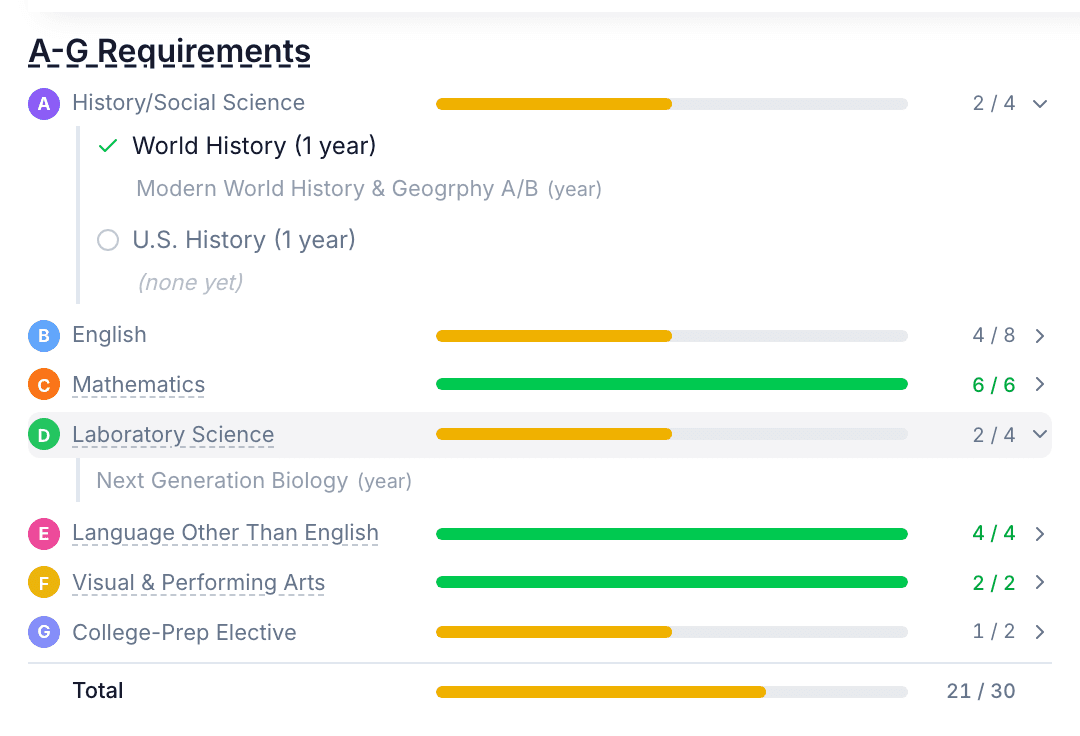
Green means an area is fully met. Amber means it's in progress — you've started but there's more to do, or you've hit the year count yet still need something specific inside it (a year of U.S. history, a second lab science, a language through level 2). Click any area to break it down course by course, with a check or an open circle on each sub-requirement. It's the fastest way to catch a gap years before it becomes a problem.
What's next
A-G eligibility and your GPA are the two halves of admission readiness. Once your courses are in, the planner also shows your live UC and CSU/SLO GPAs and how they compare to each campus — see How to Calculate Your UC GPA and How UC Campus Matches Work.
Note: A-G rules follow UC's published subject requirement. Always confirm course approval and validation with your school counselor.