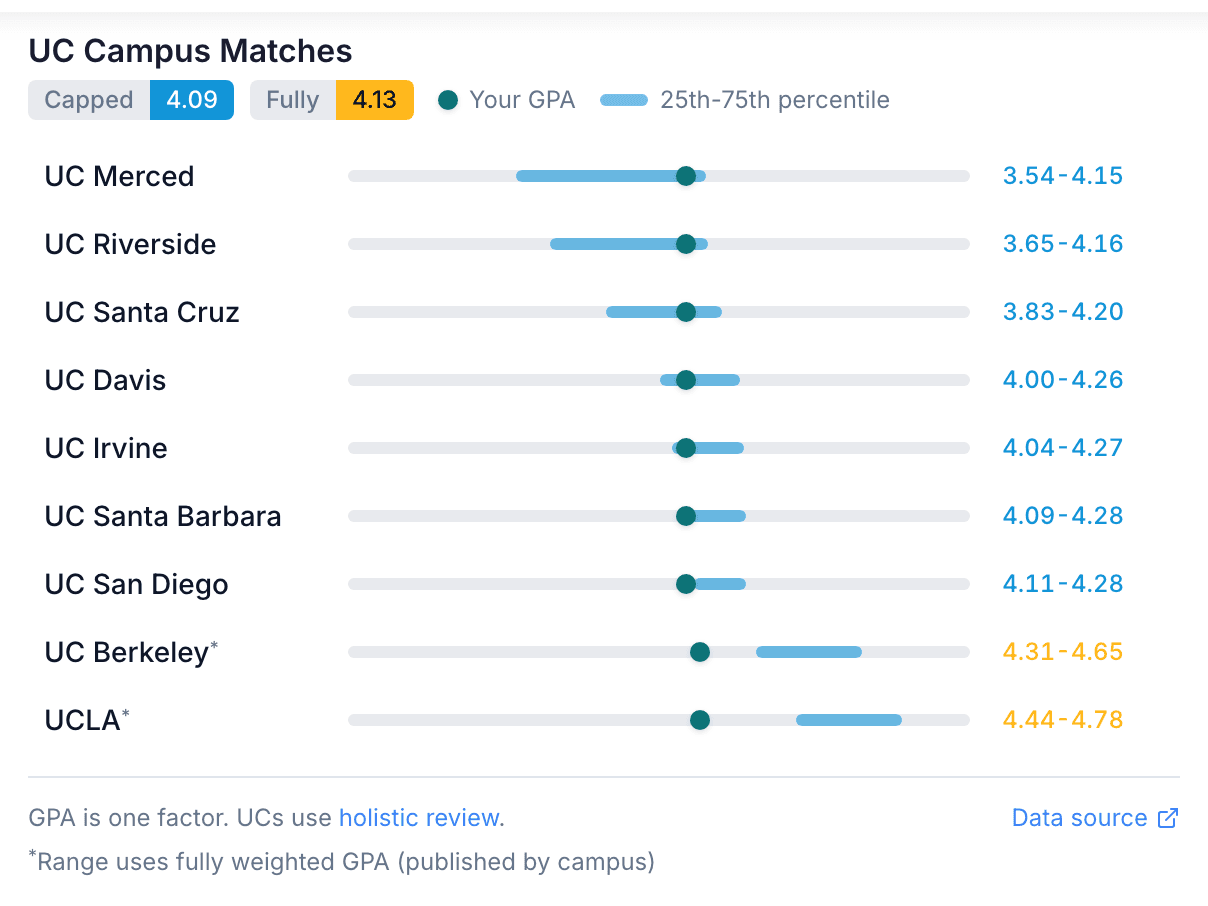
You know your UC GPA - but is it enough for the campuses you have in mind? UC Campus Matches answers that by placing your GPA against the GPA range of students recently admitted to each UC campus, so you can see where you stand. Here's where the numbers come from, what the range means, and one detail that trips people up: a couple of campuses are scored on a different GPA.
Where the numbers come from
The ranges come straight from UC's official admit data - the systemwide first-year admit data pages, supplemented by individual campus profile pages where a campus publishes more detail. Capped-weighted ranges are from UC's systemwide data; the fully weighted ranges come from campus profiles. The tool links to the source under every comparison, so you can check any figure yourself.
What the range means
Each campus shows the middle 50% of admitted students - the band from the 25th to the 75th percentile of their GPAs. Your own GPA is the dot. Above the band, your GPA is higher than three quarters of the admitted class; inside it, you're in the middle of that class; below it, you're under most of it. The band is deliberately honest: a quarter of admitted students sat below it, so a GPA under the range makes admission less likely, not impossible.
The catch: not every campus uses the same GPA
This is the detail worth knowing. Most UC campuses report their admitted-student GPAs as Capped Weighted - UC's main GPA, with the honors bonus limited to 8 points - so Campus Matches compares those against your capped number.
But UCLA and UC Berkeley publish their admit profiles in Fully Weighted GPA - every eligible honors point counted, no cap. For those two campuses the tool switches to your Fully Weighted GPA so the comparison is apples-to-apples and marks their range in gold. That's why Berkeley's and UCLA's ranges sit higher than the others': they're measured on a taller scale. If you compared your Capped Weighted GPA to their Fully Weighted range, you'd scare yourself for no reason.
New to Capped Weighted vs. Fully Weighted? How to Calculate Your UC GPA explains both.
GPA is one factor
The matches are a reality check, not a verdict. UC reads applications holistically - course rigor, your personal insight questions, context, and your intended major all move the needle, and impacted majors run far more selective than a campus's overall range. Treat a GPA above the range as breathing room and one below it as a reason to apply thoughtfully, not a closed door.
What's next
Campus Matches opens from any GPA in the Courses planner, next to Cal Poly San Luis Obispo's ranges by college, and also appears on the Colleges tab in My Path, where a star on any campus adds it to your college list. It updates as you add courses in the planner or either GPA calculator. To understand the GPA the matches are built on, start with How to Calculate Your UC GPA.
Note: Admit ranges come from UC's published data and change yearly. They describe past admitted classes - they don't predict an individual decision.